A strategic shift is required of corporations for them to be effective in a turbulent and disruptive world while continuing to be competitively and economically sustainable. The current economy fails to work for its citizens, even while its citizens work for the economy. Globalized neoliberalism and market-driven approaches are failing to serve the singular nature of citizen interests, other than for the very rich ones.
Turbulence and the limitations of traditional economics
Turbulent environments are the fourth in a sequence describing how corporations must compete as they adapt to an increasingly demanding environment. The first two of these environments, placid randomized and placid clustered, move a corporation from just doing what it does anywhere, because its customers are everywhere, to doing what it does where its customers are clustered. In the third of these environments, disturbed reactive, a corporation targeting a cluster must also make its offerings competitive with the offerings of the other corporations targeting the same cluster.
All three of these environments rely on a one-sided relation to demand defined symmetrically by the markets the corporation has chosen to target. In the fourth turbulent environment, however, this one-sided relation can no longer be sustained because customers’ demands becomes dynamic and multi-sided, driven by the singular nature of each customer’s context-of-use. In a turbulent environment, demand becomes asymmetric and the corporation has to follow its customers.[i]
The limitation created by traditional economics arises through not being able to move beyond the sole pursuit the economies of scale and scope based on market-driven approaches. This limitation means that customers must do the work of adapting what’s being made available by suppliers to their singular requirements. To overcome this limitation in turbulent environments, corporations must add the pursuit of economies of alignment in an economics of singularity, an economics in which a corporation must come ‘alive’ to its singular ‘others’.[ii] Instead of customers being restricted to orchestrating and synchronizing what the markets will supply, corporations begin to do this work for customers as their demands becomes increasingly dynamic and asymmetric.
The Lines of Development and the Value Stairs
Below a corporation’s strategy ceiling is operative organization, describable as a socio-technical system with its primary tasks etc. Different spans of complexity describe the different ways in which these primary tasks may be defined in response to the competitive dynamics of their environment[iii]:
- replicating the use of given capabilities, referred to as r-type;
- concrete ways of using a range of r-type capabilities to secure pre-defined outcomes defined by a vertical structure of accountabilities and responsibilities, referred to as c-type;
- the systematic orchestration of a number of c-type composite capabilities using know-how to align them in pre-defined ways to a customer’s situation, referred to as K-closed; and
- the comprehensive orchestration and synchronization of a number of c-type composite capabilities using know-how to make their use cohere within a customer’s context-of-use, referred to as K-open.
Each of these types of primary task becomes possible through Lines of Development (LoDs) of the Corporation that make that type of primary task possible and sustainable:
- Providing r-type capabilities able to capture economies of scale.[iv]
- Creating role hierarchies with the forms of accountability and responsibility needed to enable c-type customization of underlying r-type capabilities to market segments, adding economies of scope to underlying economies of scale.[v]
- Establishing a shared narrative framing with customers of how the corporation organize K-closed access to solutions by its customers, adding to economies of scale and scope by capturing value from creating economies of alignment for the customer[vi].
- Enabling multiple behaviors to cohere within a singular customer’s context-of-use in a K-open way that is directly and indirectly effective, adding to economies of scale, scope and alignment by capturing value from the way it creates economies of governance for the customer through the way it does this[vii].
While the first three of these can be pre-defined because of their one-sided definitions of their targeted markets, the fourth of them requires a different ‘horizontal’ relation to the customer’s context-of-use because of its dynamic nature.
When looked at from above the strategy ceiling, these different ways of defining primary task have to be placed within a commercial frame. This commercial frame enables the referent/regulative organization to determine how value is to be created for the corporation’s customers by its operative organization at the same time as how value is to be captured from those customers, hopefully profitably! This commercial frame is the pre-contractual context within which the contract is formed, the context determining what form the contract needs to take.
Thus an r-type contract is put in place within a c-type pre-contractual context, a c-type contract within a K-closed context, and a K-closed contract within a K-open context. The pre-contractual context within which a K-open contract is formed is again of a different nature that requires a situational understanding[viii] of the indirect effects the customer is trying to achieve in relation to the value deficit driving that customer.
Aligning commercial frames with the different kinds of primary task to be delivered can be described in terms of a value stairs, the diagonal of which reflects the balancing of a primary task requirement with the commercial frame needed to frame the customer relationship:
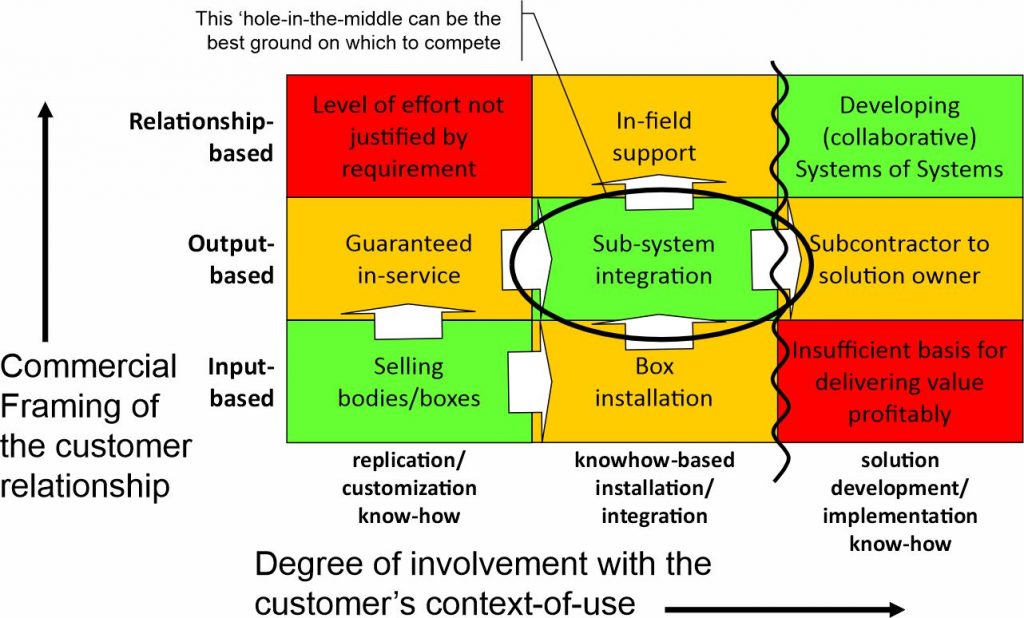
Figure 1: The hole in the middle
- For the r-type and c-type contracts, an input-based contract is sufficient to define what will be delivered, assuming appropriately defined supply-side contingencies that need to be excluded.
- For the K-closed contracts, an output-based contract is needed to specify what outcomes will be achieved, again with appropriately defined contingencies needing to be excluded.
- For the K-open contract, a relational contractual frame needs to further add the relationship with the customer’s context necessary to managing the dynamics of the service to be delivered. To do this the contract has to be able to specify the indirect effects to be created within the customer’s context-of-use.
The Hole-in-the-Middle – the Mandate for Doing More
The traditional one-sided approach that corporations take to demand leaves any demand asymmetry in the hands of the person dealing with the individual customer, the person-at-the-edge. The corporation does this in the form of a Faustian Pact with that person. S/he can do whatever is needed to keep the customer happy so long as the corporation gets what it wants. This can lead to that person being tipped very well and/or suffering burn-out through the additional efforts needed to keep the customer happy. Either way, the corporation doesn’t learn from the extra effort that the person-at-the-edge has to make.
The gap between what the corporation is prepared to offer and what is required to meet the asymmetric demands of the customer creates a hole in the middle of the corporation’s organization. This hole-in-the-middle (HiM) is between the referent/regulative organization above the ceiling and the operative organization below. It reflects a systemic faultline between the corporation’s siloed definitions of services and the ways in which they can be dynamically aligned to the singular demands of the customer.
The r-type and c-type contracts on the left in the figure above are easily delivered by hierarchies. The K-open contracts on the right of the figure require an intimate relationship with the customer’s context-of-use. The middle column, corresponding to K-closed primary tasks, falls somewhere in between, forming a hole-in-the-middle insofar as a corporation relies on Faustian mechanisms to interpret its K-open context.
This hole arises first from the difficulty in scaling the processes of orchestration across many customers (rather than simply outsourcing them to a service organization). It arises second because the Faustian pact with the person-at-the-edge also prevents the organization from learning about new opportunities for innovation and development.
The economics of singularity and the need for Asymmetric Leadership
K-type relationships become critical in turbulent environments creating the need for a Third Epoch approach that can include an economics of singularity through the way the corporation can orchestrate and synchronize composite services at scale, i.e., in large numbers. This involves not only adding new capabilities to the operative organization. It also involves developing new forms of leadership that can balance vertical accountabilities with the horizontal responsiveness needed to pursue sustainable and dynamic adaptation, an approach to leadership that assumes asymmetry.
This in turn involves leadership being able to balance all four kinds of value proposition and their associated LoDs by understanding the corporation either as part of a larger ecosystem in which some form of balance can be sustained across its interdependencies and collaborations, or by realizing that it is itself an ecosystem.[ix] Either way, the ecosystem has to be defined structurally[x] by the way it is creating value for its end-users and must necessarily balance all four forms of LoD[xi].
Of course the impact of turbulence can be ignored by a corporation so that it can lock down the particular form of value creation it has chosen to dominate. The danger in this approach is that the corporation becomes maladaptive within its larger environment to the point where it is unable to survive the reactions of its ‘others’ to its intransigence, whether those ‘others’ are its competitors or its customers!
Notes
[i] These are the four causal textures identified by Emery and Trist (Emery and Trist 1965)
[ii] ‘Aliveness’ involves all four LoDs being engaged with the behaviors of the structural ecosystem.
[iii] These are the bottom four layers of Jaques’ levels of abstraction (Jaques, Gibson, and Isaac 1978), defined as Lines of Development (LoDs). These describe what is needed to address the progressively more complex causal textures of the environment described by Emery and Trist:
- r-type providing effective capability (supporting the Discourse of the Hysteric),
- c-type structuring accountability and responsibility (supporting the Discourse of the Master),
- K-closed providing of a shared narrative framing (supporting the Discourse of the University), and
- K-open bringing things together (cohesion) within the customer’s context-of-use (supporting the Discourse of the Analyst).
These LODs are cumulative in that each one depends on being supported by its prior LoDs.
[iv] This is providing materiel and technology necessary to doing this.
[v] This providing the facilities, infrastructure and logistics that make this possible.
[vi] This is having the personnel and a shared culture enabling a common knowledge-based approach to managing supply-side logistical complexity on behalf of its customers, e.g., supermarkets or insurance companies.
[vii] This is ensuring that there is mission alignment and interoperability across all the behaviors, adding synchronization of behaviors to the orchestration of aligned products and services, e.g. a heart operation or a construction project.
[viii] This involves ‘intelligence’ (in the military sense) interpreting the meaning of observable patterns of behavior (3-category objects) within the context of the wishes and desires of the customer as they are being pursued within the customer’s context-of-use. These interpretations are of the pragmatic implications of the discursive interactions being observed in the customer’s environment.
[ix] These four LoDs (r-type, c-type, K-closed and K-open) are four different ways of creating sustainable value as part of an ecosystem. The first three of them can be defined hierarchically using a one-sided approach to demand. The fourth cannot, requiring collaboration with the other three across the ecosystem. It is important to note, here that a structural ecosystem itself interacts with a geontological context, the relation to which may become toxic for the ecosystem… See (Povinelli 2016)
[x] A structural ecosystem is defined by the effects it creates in its environment, to be distinguished from an ecosystem defined by affiliation.(Adner 2017) For a corporation may always be understood as an ecosystem defined by filiation. For it to understand itself to be a structural ecosystem means that it has already grasped the necessity for asymmetric leadership. As such, it remains structurally coupled to the larger geontological and biological medium.
[xi] These LoDs are providing effective capabilities (supporting the Discourse of the Hysteric), structuring accountability and responsibility (supporting the Discourse of the Master), providing a shared narrative framing (supporting the Discourse of the University), and bringing things together with the context-of-use (supporting the Discourse of the Analyst).
References
Adner, Ron. 2017. ‘Ecosystem as Structure: An Actionable Construct for Strategy’, Journal of Management 43: 39–58.
Emery, F.E., and E.L. Trist. 1965. ‘The Causal Texture of Organizational Environments’, Human Relations, 18: 21–32.
Jaques, E., R.O. Gibson, and D.J. Isaac (ed.)^(eds.). 1978. Levels of Abstraction in Logic and Human Action (Heinemann: London).
Povinelli, Elizabeth A. 2016. Geontologies – A Requiem to Late Liberalism (Duke University Press: Durham and London).