I want to make a subtle change to how we can think of organizations as living systems. My purpose is to improve the way of thinking about organizations as extimate symptoms. Essentially, it is us speaking beings who are alive. Whether or not an organization is alive depends on how we are choosing to use it. For an organization to be ‘alive’, then, we need to be thinking in terms of the Libidinal Economy of Discourse (LEoD) describing its referent/regulative organization supported by the operative organization of its behavioral strategies.[1]
Speaking being
To be a speaking being starts from understanding ourselves to be biological systems qua living systems. To this we can then add the entanglement of our neural networks with our embodiment. The subtle change is first in modeling a living system as having a quadripod dynamic structuration of relations between the four causes (Figure 1), the quadripod being modeled by three ontic, epistemic and relational ‘cuts’ implicit in its behaviors that are singular to its way of being alive. Second, it is in understanding that a biological living system exhibits some combination/composition of four different kinds of behavioral strategy (Line of Development or LoD), each realizing a different relation between the selection-replication-repair-metabolism quadripod through which it deals with the environment with which it is structurally coupled.
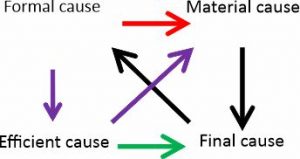 Figure 1: The ‘Living System’ Quadripod
The Lacanian quadripod (Figure 2) then describes the entanglement of our neural networks with our embodiment as a biological living system. It is this entanglement, in itself radically unconscious, that gives rise to (what Freud referred to as) a ‘psychic apparatus’. In this entanglement, the individual experiences an impotent relation of ‘truth’ to his or her singular relation to an originating loss, the repetition of which relation is experienced as the production of a discourse (bottom-right in Figure 2). Realized socially through the Peircean quadripod[2], this gives rise to four different forms of discourse. Each one reflects a different generative strategy for bringing the social into relation with this radically unconscious lack, each not only a different way of being in relation to pleasure/pain (top-right) but also to the plus-de-jouir of being in relation to an originating lack (bottom-right).
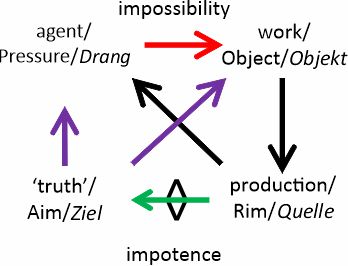 Figure 2: The Lacanian Quadripod
From this follows a socially-mediated generative relation to pleasure/pain (the ‘pleasure principle’) supported by the operative means by which we deal with our ‘reality’ (the ‘reality principle’) represented by four LoDs. The resultant LEoD relates the referent/regulative four generative discourses to the four operative LoDs of our embodiment and is an emergent effect of how we live our life. The three-moments-and-three-crises speak about transformations in what form the ‘truths’ take in how we are living that life. In these terms, the organizations that an individual ‘uses’ are extimate symptoms of his or her way of living his or her life.
Organizations as extimate symptoms
This brings us to our experience of organizations as mediating the way our identifications are supported by the nature of the ‘truths’ that they provide support for. In a creative process, an individual seeks to be supported in a generative relation to his or her ‘truths’, even though this support may in fact be being constrained by (what are presented as) organizational necessities. The presence of an impasse between the generative and the operative takes the form of a strategy ceiling[3], the challenging of which leads to a process in which the double task of balancing individual need with role requirement has itself to be doubled in order also to balance the interests of the value-capturing operative organization with the referent/regulative interests of those benefiting from its value-creating roles.
The level of this strategy ceiling is an effect of the nature of the referent/regulative identifications of those individuals with the power to command obedience to the organization’s operative behavioral strategies. Some of these identifications will be with the ‘truths’ supported by the organization’s behavioral strategies. Some, however, may be with other aspects of their lives. The LEoD, then, is a way of describing the systemic characteristics of the unconscious dynamics between those individuals with the power to command obedience from the operative organization.
In this LEoD, the four generative discourses have a ‘live’ relation to the unconscious and lack. In contrast, the four perverse discourses are supported by the LoDs of the operative organization. These perverse discourses, while they are inherently unstable as ways of giving agency to the relation to lack (bottom-right) of a discourse (hence perverse), they are stabilized by their ‘truth’ being identified with the LoDs of the operative organization. Each generative discourse in a LEoD is in a different kind of relation to each of these four perverse discourses through relations of dependency, pairing, affiliation[4] and fight-flight. The four Lines of Development[5] refer to an organization’s behavioral strategies that correspond to the different forms of support they are providing to the perverse discourses in the LEoD.
Why, then, would we want a referent/regulative organization to be alive to its operative organization? Because for it not to be alive is to risk the operative organization becoming maladaptive to its environment with all the consequences for those supported by it and for others in the wider society, consequences of scapegoating, turning a blind eye and the discluding of ‘otherness’. To avoid this maladaptation, there has to be a circulation of discourses within the LEoD, with which comes the ability to engage creatively with
- what is the organization’s place as a value-creator within the larger structural ecosystems of which it is a part;
- what is the externalist impact of accelerating demand tempos on the dynamic responsiveness of its value-creating place; and
- what these ecosystemic and externalist consistencies require of its internalist ways of capturing value defined by its structured of accountability and responsibility.
Notes
[1] These behavioral strategies are the r-type (archaea), c-type (protobiota), K-closed (bacteria) and K-open (eukaryota) strategies identified with different ways of creating value aka being ‘selected’. Taken together, the referent/regulative organization with its operative organization are the realization of (in Deleuze’s terms) an Event.
[2] In the Peircean quadripod, the relation to doubt is added to the Peircean three: S1 = Thirdness, S2 = Firstness, $ = Secondness, (a) being in the place of the relation to doubt.
[3] An employee may question behaviors below the ceiling in operative terms, questioning behaviors above the ceiling is ‘none of your business’ because it is constituted by referent/regulative taken-as-given identifications.
[4] Affiliation = follow what I say and not what I do, contrasting with dependency as the reverse of this.
[5] Four generative discourses/leadership: Edge Outcomes/providing effective capabilities (Hysteric), Leadership and Education/structuring accountability and responsibility (Master), Doctrine and Operational Concepts/providing a shared narrative framing (University), and Situational Understanding/bringing things together with the context-of-use (Analyst).
Four behavioral strategies/Lines of Development: Materiel and Technology (r-type), Facilities, Infrastructure and Logistics (c-type), Personnel and Shared Culture (K-closed), Mission Alignment and Interoperability (K-open). The corresponding perverse discourses are Science (suppressing questioning, contradictions and incompletenesses), Capitalism (clinging to the illusion of stability), Masquerade (becoming trapped in its own success stories) and Movement (dismissing and excluding the other’s relation to lack).